

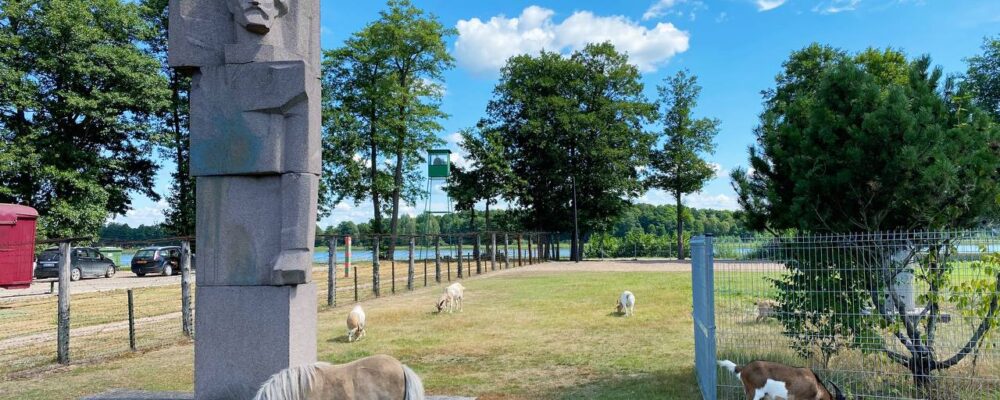
Grūtas Park, about 5 km from Druskininkai, brings together monuments and propaganda objects removed from Lithuanian public spaces after independence was restored. It can be a useful place to study how an occupying regime used art, scale and repetition to project power—but only when the objects are viewed with historical context and a critical eye.
This guide does not celebrate Soviet symbols or the people represented by them. Lithuania was occupied and annexed by the Soviet Union in 1940, occupied again in 1944, and subjected to repression, imprisonment, deportation, censorship and forced Sovietisation. The sculptures in Grūtas Park were created within that system and originally functioned as instruments of state propaganda.
What is Grūtas Park?
Grūtas Park opened in 2001 as a private open-air exhibition near the village of Grūtas. Its best-known section displays Soviet-era statues that were dismantled across Lithuania after 1990. Indoor exhibitions add posters, photographs, documents and other material connected with the machinery of Soviet political and cultural control.
Moving the monuments away from squares and government buildings changed their meaning. They no longer dominate civic space or demand public reverence. Instead, visitors can examine them together as evidence of how monumental imagery was used to make an authoritarian system appear permanent and heroic.
Why the site is controversial
Grūtas Park is not a neutral collection. Scholars and visitors have long debated whether relocating propaganda to a museum setting helps society confront the past or risks turning repression into spectacle and nostalgia. The combination of historical displays with entertainment and commercial elements can make that boundary especially uncomfortable.
A thoughtful visit therefore asks questions rather than simply photographing the statues: Who commissioned this object? Whose power did it serve? What was excluded from the official story? How did occupation affect ordinary Lithuanian families? What changes when a monument is removed from its original square and placed in a landscaped park?
Important context: preserving an object for study does not mean honouring the ideology it once promoted. The value of the visit lies in recognising propaganda techniques and understanding the human cost hidden behind heroic imagery.
What you will see
- An outdoor sculpture route with large monuments and busts formerly displayed in Lithuanian towns and cities.
- Museum rooms containing political posters, printed material, photographs and everyday objects from the occupation period.
- Recreated surveillance and confinement imagery, including watchtowers and barbed-wire motifs. These should be approached as interpretive devices, not authentic camp remains.
- Historical labels that identify many objects and the figures represented.
The park also contains family-entertainment and catering areas. Visitors may find the contrast with the history unsettling; that tension is part of why the site continues to prompt debate.
How to visit responsibly
- Learn the basic timeline first. Lithuania’s first Soviet occupation began in June 1940; Soviet rule was reimposed in 1944 and lasted until independence was restored in 1990.
- Read beyond the nameplates. Notice the artistic language—idealised bodies, heroic poses and oversized scale—and ask what political message it was designed to communicate.
- Avoid celebratory poses with symbols of repression. Treat the collection as difficult heritage rather than a playful Soviet-themed backdrop.
- Pair the visit with testimony about victims and resistance. In central Druskininkai, the history of Druskininkai provides a wider local timeline. The town’s Resistance and Exile Museum adds personal context about repression, deportation and opposition to Soviet rule.
- Discuss what museums owe their audiences. Grūtas Park is a useful case for thinking about whether interpretation, location and commercial presentation can transform propaganda into education.
Practical information from Druskininkai
Address: Grūtas, LT-66441, Druskininkai municipality.
The park is approximately 5 km from Druskininkai in the Vilnius direction along the A4. It is easiest to reach by car, taxi or bicycle; local public transport may also be available. The official Druskininkai cycling information describes a longer forest route towards Grūtas Park for confident riders.
The attraction is open year-round, but hours vary by season. Check the official contact page before departure. Allow roughly two to three hours if you plan to read the exhibition material rather than only walk past the sculptures.
Is Grūtas Park suitable for children?
Families can visit, but adults should explain what the symbols represented and why the monuments were removed from public space. Some imagery connected with imprisonment and repression may require preparation. The mini-zoo and playground are separate from the historical value of the site and should not replace an age-appropriate conversation about occupation.
A wider day around Druskininkai
Grūtas Park works best as one part of a broader history-focused day. Combine it with the Resistance and Exile Museum and then return to the centre for the wooden-architecture walking route. For more ideas, browse our guide to things to do near Domi Lini.
Domi Lini is a calm base in Druskininkai for exploring southern Lithuania. See our apartments and holiday house when planning your stay.
Sources and further reading
- Druskininkai Tourism: Grūto Park
- Grūtas Park: exhibition overview and visitor information
- Lithuanian Ministry of Foreign Affairs: the path towards independence
- Research on the musealisation of Soviet heritage at Grūtas Park