

Druskininkai is usually associated with mineral water, pine forests and spa treatments. Yet the resort can also be explored as an open-air gallery. Sculptures appear beside springs, bridges, lakes and pedestrian avenues, making public art part of an ordinary walk rather than something confined to a museum.
This self-guided route introduces several of the most interesting sculptures in Druskininkai. It combines established twentieth-century works, monuments connected with M. K. Čiurlionis and newer installations that continue the town’s artistic story. Allow approximately 90 minutes to two hours if you want to stop, photograph the works and read about their background.
Public art in a resort landscape
Sculpture in Druskininkai is closely connected with the development of the resort’s parks and pedestrian spaces. Some works were created when the town was being extensively redesigned during the Soviet period. Others appeared after Lithuanian independence or form part of current cultural projects.
Not everything commissioned during the Soviet period was ideological. Sculptors also produced lyrical, nature-related works that became part of the town’s identity. Ratnyčėlė, for example, has outlived its original period and is now one of the most recognisable symbols of Druskininkai.
Art historian Ramutė Rachlevičiūtė has noted that Druskininkai is particularly interesting for its ensembles and sculpture parks rather than only isolated monuments. The relationship between art, greenery, water and architecture is what makes the town’s public art distinctive.
1. “Prie šaltinio” — beside the mineral spring
A natural place to begin is Gydyklų Park, the historic centre of Druskininkai’s mineral-water tradition.
The sculpture Prie šaltinio—“Beside the Spring”—was created by Lithuanian sculptor Antanas Dimžlys in 1964 and placed in the resort park around the following year. Its location near the former mineral-water pavilion connects the human figure with the element that gave Druskininkai its purpose as a spa town.
Dimžlys belonged to a generation of Lithuanian sculptors who gradually moved towards more monumental, simplified forms. The Lithuanian Universal Encyclopedia identifies Prie šaltinio as one of his notable works.
2. “Karūnos” — a royal story beside the Nemunas
Nearby stands Karūnos, or “Crowns”, created by sculptors Dalia Matulaitė and Vladimiras Stankevičius in 2011.
The grey-granite monument recalls Sigismund II Augustus and Barbara Radziwiłł, whose relationship became one of the best-known love stories in the history of the Grand Duchy of Lithuania. Their marriage faced strong political opposition, while Barbara’s early death helped turn the historical episode into a lasting cultural legend.
Rather than illustrating the couple literally, the sculptors used the crowns as symbols of love, authority, loss and shared historical memory. The work also reflects cooperation between Druskininkai and the Polish city of Augustów.
3. Ratnyčėlė — the enduring symbol of Druskininkai
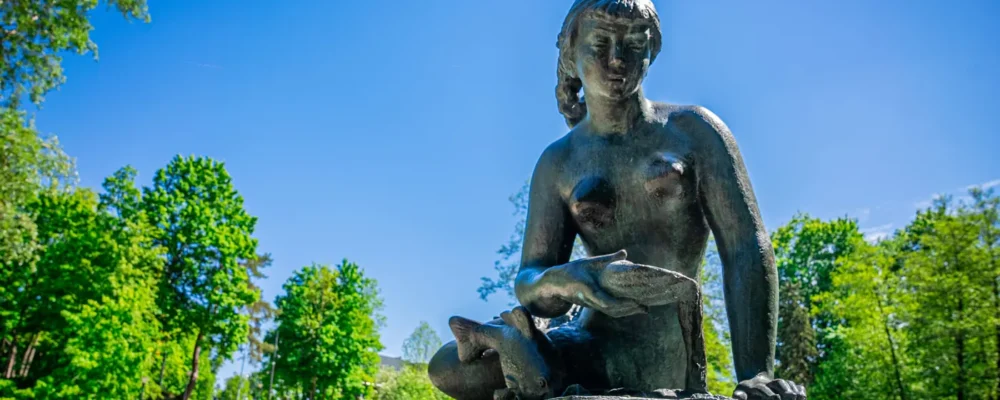
Continue towards the Ratnyčia stream and its curved pedestrian bridge. On the left bank stands Ratnyčėlė, a graceful female figure bending towards the water.
The work was created by Bronius Vyšniauskas in 1959. Local accounts sometimes give 1962 as the year it was installed beside the stream, explaining the two dates occasionally associated with the sculpture.
Vyšniauskas was a major Lithuanian sculptor whose public works combined classical figure-making with a more monumental twentieth-century style. Here, however, the result is intimate: the figure appears to scoop water in her hands, linking the sculpture with the stream and the identity of a mineral-water resort. Ratnyčėlė became such a recognisable town symbol that miniature versions are presented as awards to people who have made an important contribution to Druskininkai.
4. The monument to M. K. Čiurlionis
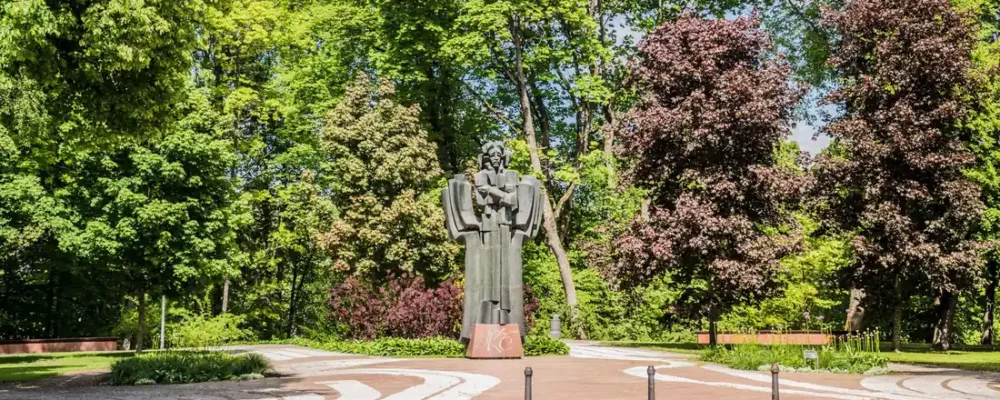
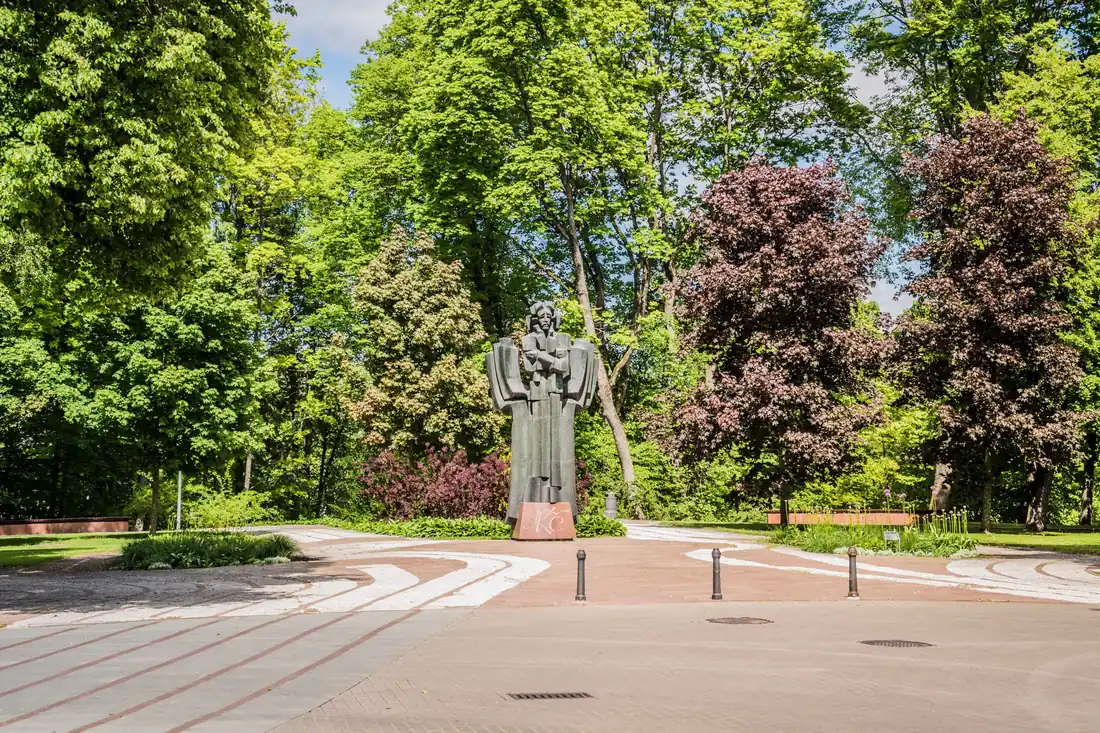
The monument to Mikalojus Konstantinas Čiurlionis was unveiled in 1975, marking the centenary of the artist and composer’s birth. It was created by sculptor Vladas Vildžiūnas with architect Rimantas Dičius.
Čiurlionis spent much of his childhood in Druskininkai, where his father worked as a church organist. The landscape around the town—the forests, water and changing light—became part of the imaginative world later expressed in his painting and music.
The monument is designed as more than a portrait. Čiurlionis’s face appears between massive rising forms that resemble wings. Light-coloured paths with red-granite details lead pedestrians towards the work, making the surrounding square part of its composition. The official description explains how the design reflects the artist’s search for light and harmony.
For a broader introduction to the artist and his hometown, continue with our guide to Čiurlionis, Jacques Lipchitz and the museums of Druskininkai.
5. The new Čiurlionis Zodiac sculptures
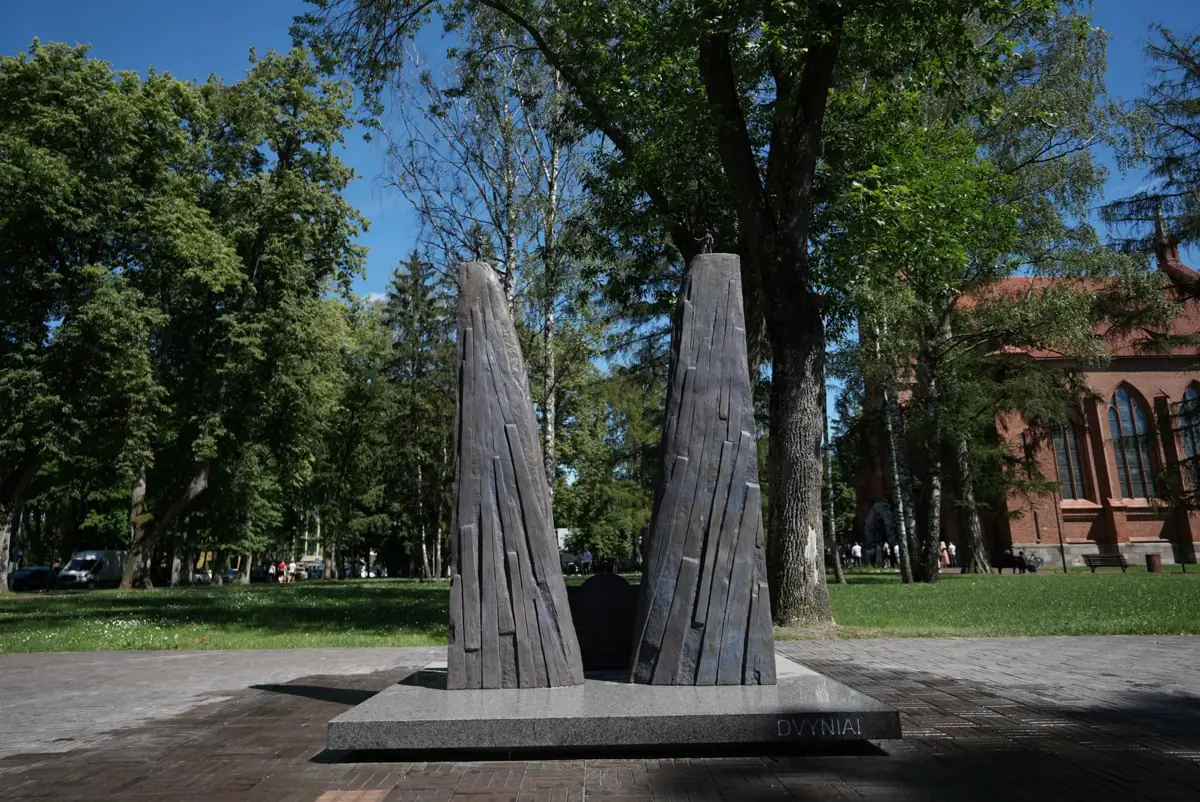
Vilniaus Avenue adds a contemporary chapter to the Čiurlionis story. Druskininkai is developing a series of bronze sculptures inspired by the artist’s celebrated Zodiac cycle.
Avinas—Aries—was the first work installed, followed by the almost three-metre-high Dvyniai, or Gemini. Sculptor Donatas Dovidavičius developed the winning concept for the planned twelve-part ensemble.
These works are not copies of Čiurlionis’s paintings. They translate his symbolic constellations into three-dimensional forms suited to a pedestrian avenue. The project demonstrates how Druskininkai continues to interpret Čiurlionis rather than treating him only as a historical figure. Because the series is still growing, returning visitors may discover additional signs of the Zodiac on future walks.
6. Musical Square
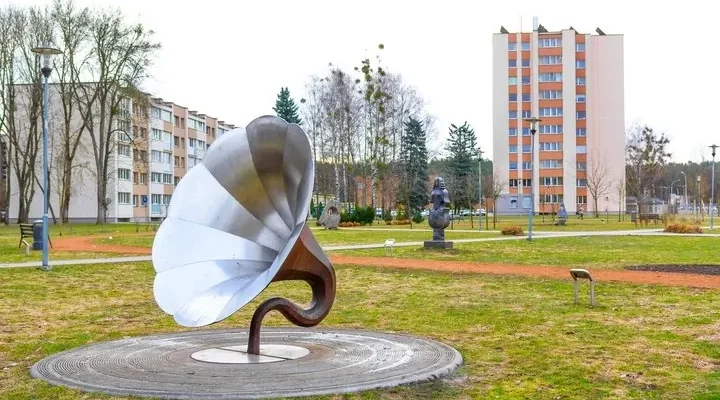
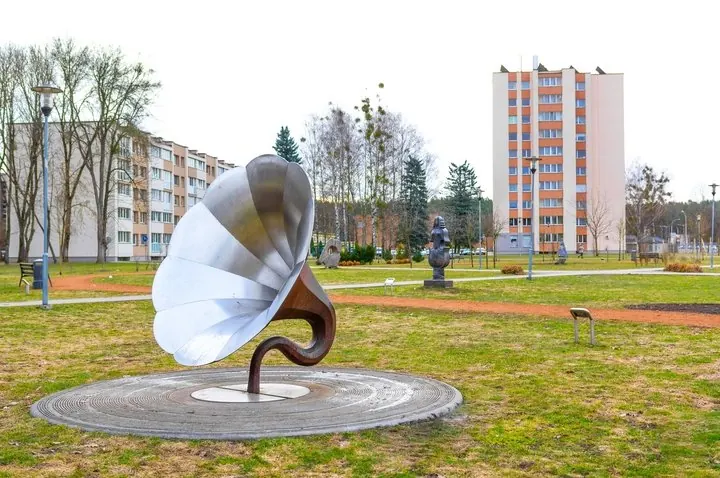
Beside the M. K. Čiurlionis Art School, Muzikinis skveras, or Musical Square, brings seven playful sculptures together in one small park.
The works are presented as seven “notes of nature”, creating a link between sculpture, landscape and the musical education taking place nearby. Artūras Burneika’s sculpture Relax was recognised as Lithuania’s best public-space sculpture in 2009. This is one of the clearest examples of Druskininkai using sculpture as an ensemble: the works respond to one another and to the surrounding park rather than functioning as unrelated objects.
7. “Gimtadienis” beside Lake Druskonis
Near Lake Druskonis, look for Gimtadienis, or “Birthday”, created by sculptor Ksenija Jaroševaitė in 1987.
Jaroševaitė is known for concise, expressive forms, often presenting the human figure with warmth and quiet humour. Gimtadienis belongs to the less formal side of Druskininkai’s public art: it is a work encountered during a lakeside walk rather than approached through a ceremonial square.
8. Jacques Lipchitz and modern sculpture
Druskininkai was the birthplace of Jacques Lipchitz, one of the major sculptors associated with Cubism. Born Chaim Jacob Lipchitz in 1891, he studied in Vilnius and Paris before developing an international career in France and the United States.
The town remembers him through the Jacques Lipchitz Museum, a commemorative bench and a sculpture park containing works created during symposia named after the artist. This part of the walk opens a wider question: how does a small resort remember an artist whose career became international? The answer is spread across several places rather than represented by a single monument.
Our Jewish heritage walk in Druskininkai provides the historical context for Lipchitz’s family and the Jewish community into which he was born.
9. Contemporary art beside Lelija
The area around the former post-office building and Lelija cultural space brings the route into the present.
Danas Aleksa’s sculpture 0.01 sekundės—“0.01 Seconds”—was created in dialogue with asteroid 2420 Čiurlionis, which orbits between Mars and Jupiter. The work combines cosmic scale with a fleeting unit of time and incorporates facial references to Čiurlionis.
Its placement beside a contemporary cultural space is appropriate: it does not simply commemorate the artist but uses his legacy to provoke a new idea. Read more about the exhibitions and events held here in our guide to Lelija Cultural Space and Menų Kalvė.
Optional extension: A. Česnulis Sculpture Park
Visitors particularly interested in sculpture can extend the day beyond the town centre to the private Antanas Česnulis Sculpture and Recreation Park, approximately five kilometres from Druskininkai.
The park presents large wooden sculptures and compositions in a forested landscape. It is a separate destination rather than part of the central walking loop, so check current opening arrangements before travelling.
Practical tips for the sculpture walk
- Most central outdoor sculptures can be visited free of charge.
- Allow 90 minutes to two hours for the principal route.
- Comfortable shoes are useful because the walk crosses parks and lakeside paths.
- Do not climb on sculptures unless a work is explicitly designed for interaction.
- Combine the walk with the Čiurlionis Memorial Museum, Jacques Lipchitz Museum or an exhibition at Lelija.
- Check current access information before visiting indoor spaces or the Česnulis park.
Where to stay
Domi Lini provides a convenient base for exploring central Druskininkai on foot. A sculpture walk can be combined with museums, cafés, Druskonis Lake and the musical fountain without turning the day into a rushed itinerary.
Browse our rooms and rates or explore the wider selection of attractions near Domi Lini.
Frequently asked questions
Is there a sculpture park in Druskininkai?
Yes. Musical Square and the Jacques Lipchitz sculpture park are central public-art spaces. The Antanas Česnulis Sculpture Park is a separate attraction outside the town centre.
Which is the best-known sculpture in Druskininkai?
Ratnyčėlė is one of the town’s most recognisable symbols. The monument to M. K. Čiurlionis is another essential stop because of the artist’s close relationship with Druskininkai.
Is the sculpture route suitable for families?
Yes. The route follows public parks, pedestrian streets and lakeside areas. Children may particularly enjoy the playful works in Musical Square, although sculptures should not be climbed unless interaction is explicitly permitted.
How long does the walk take?
Allow approximately 90 minutes to two hours for the central route. Museum visits or the optional Česnulis Sculpture Park require additional time.